 This summer, Les Echos — France’s leading business daily — published an op-ed I wrote on a question that many organizations believe they have already answered, but in reality have not: how to win the durable commitment of Generations Y and Z.
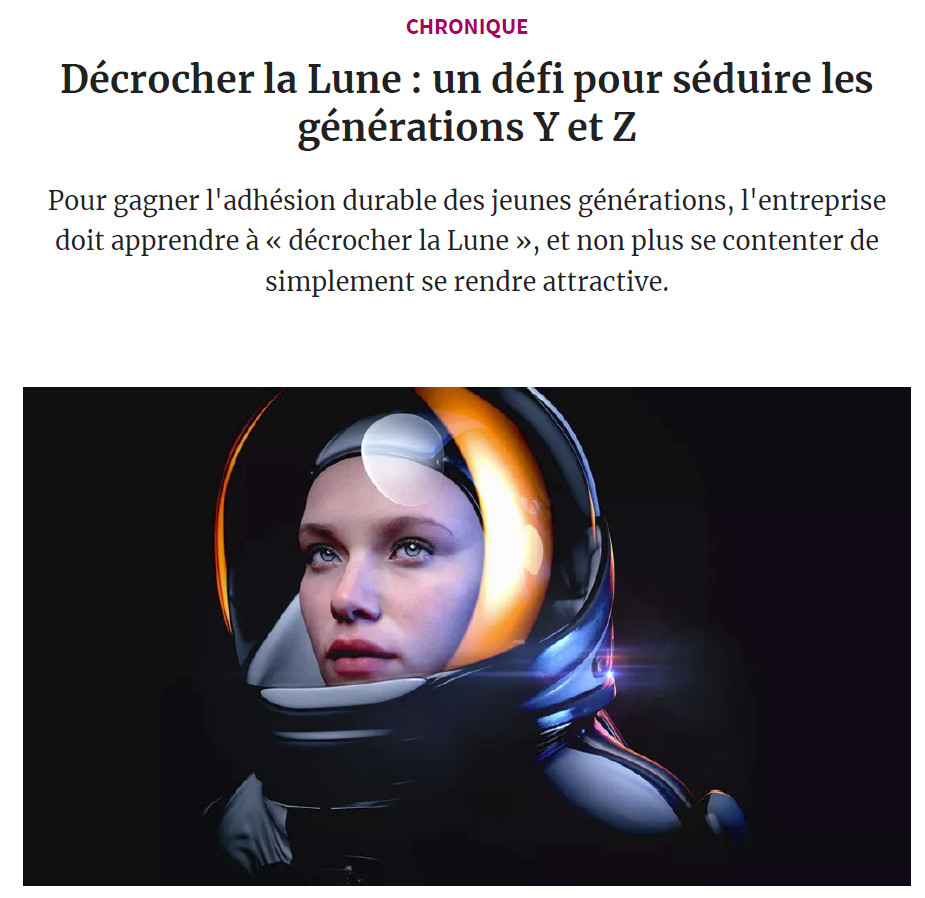
The article is titled “Reaching for the Moon: A Challenge for Attracting Generations Y and Z” and appeared in the Leadership & Management section of Les Echos on July 1, 2025.
At first glance, this may sound like yet another piece about employer branding, hybrid work, or “engagement initiatives.” It is not.
From “being attractive” to being worth committing to
My core argument is simple, but demanding: young generations are not looking for companies that merely try to attract them — they are looking for companies worth committing to.
Over the past decade, many organizations have invested heavily in what I describe as the first two stages of the rocket:
- A frictionless digital and organizational experience: Flexible work arrangements, modern tools, autonomy over time and place — often inspired by consumer apps rather than by real work design.
- A shift toward trust-based management: Managers recast as facilitators, coaching cultures, mentoring programs, individualized development paths — sometimes genuinely empowering, sometimes more cosmetic.
These two stages can indeed put a company into orbit. They make it attractive.
But they do not make it inspirational.
The missing stage: a cause that deserves commitment
What many young employees perceive — often very lucidly — is that much of today’s HR, wellbeing, and impact discourse is still designed to retain them, not to serve something larger than the firm itself.
CSR programs, purpose statements, even “mission-driven company” statutes are no longer sufficient when they remain peripheral to the core business. The gap between words and deeds is quickly detected. As the Quebec expression goes: the boots don’t follow the mouth.
What Generations Y and Z are asking for is more radical — and more coherent:
An organization that puts its core business fully at the service of society and the environment, not partially, not symbolically.
This is what I call the third stage of the rocket: the Moon of genuine commitment.
Unconditional care is not utopian — it is operational
In the op-ed, I draw on research conducted over several years across dozens of companies on three continents. These organizations — large and small, private and public — share a common trait:
They deliver unconditional care to the members of their ecosystem — customers, suppliers, and local communities — through their core business processes.
Far from weakening performance, these companies consistently outperform their profit-centered peers.
One striking example is Handelsbanken, the Swedish listed bank. For decades, it has operated without sales targets, cross-selling, call centers, or centralized budgets — and yet it delivers superior returns, top customer satisfaction scores, and one of the strongest credit ratings in global banking.
Importantly, such organizations do not need to “sell” themselves to young talent. They attract them naturally, because they offer something rare: a place where one can “reach for the Moon” — and stay there.
If they can do it, anyone can
The conclusion of the op-ed is deliberately uncompromising: if a large, regulated, publicly traded European bank can organize itself around unconditional care and still thrive, no company can legitimately claim that this path is unrealistic.
Below, you will find the full English translation of the op-ed as published in Les Echos.
Reaching for the Moon: A Challenge for Attracting Generations Y and Z
English translation of the op-ed published in Les Echos, July 1, 2025
Generations Y and Z already represent the majority of employees — and even more so in frontline roles, where economic value is created. To attract them, companies need to build a three-stage rocket. Yet many organizations remain stuck at the second stage.
Young people expect companies to offer them the opportunity to “reach for the Moon” by committing fully to serving society and the environment.
The first stage of the rocket relies on a digital experience as seamless as the apps these generations use daily. It includes the work framework and organization — where and when they want to work in order to deliver meaningful results.
But a rocket with only one stage quickly falls back to Earth, as young employees soon realize that such arrangements remain superficial and do not reflect either the quality of relationships or the substance of the work.
A second stage involves implementing trust-based management and empowerment, with managers trained and coached to become facilitators. Online learning, mentoring, individualized development paths — personal development tools play a key role, provided that young employees are free to choose them.
These first two stages allow many companies to achieve a certain level of attractiveness. But not yet to “reach the Moon” by being genuinely embraced by younger generations.
The third stage: the Moon of commitment
Dissatisfied, many young employees sense that corporate discourse — “HR policies,” quality of work life, “impact measures” — is more about retaining them than about fostering their fulfillment or offering an inspiring cause worthy of full engagement.
Neither corporate social responsibility programs nor even “mission-driven company” statutes are enough. Only 30% of Gen Y and 26% of Gen Z employees say they are satisfied with their company’s social impact — and the figures are even lower regarding environmental impact. As the Quebec saying goes: actions do not follow words.
Young people expect companies to commit fully — not partially — to serving society and the environment. Utopian? No.
Research conducted across dozens of organizations of all sizes and sectors, on three continents, reveals a shared purpose. In every case, these companies provide unconditional care, through their core business, to customers, suppliers, and local communities — and they generate higher profits than competitors focused on profitability alone.
This is the case of the Swedish banking leader Handelsbanken. Its advisors have no sales targets, no cross-selling, no call centers, no formal budgets, and no centralized strategy. Yet for fifty years, Handelsbanken has delivered a return on equity higher than its Swedish competitors, ranked number one in customer satisfaction in the UK for fifteen years, and earned the highest global credit rating among banks. Thanks to this vision, the company naturally attracts young talent eager to reach the Moon — and remain there.
If a listed European bank can provide unconditional care to its ecosystem and be embraced by young generations, then any company can do the same.